Sustainable Materials
Engineered Bamboo vs. Raw Bamboo in Bali: A Material Researcher’s Field Notes
Talisa Dwiyani

TL;DR — Raw bamboo and engineered bamboo are not interchangeable. Raw culms excel in expressive, low-carbon roof structures when they are correctly treated and kept dry; engineered bamboo behaves more like predictable timber. Most Bali projects benefit from using both in different roles.

Why this question keeps coming up
Almost every client who walks into our Ubud studio asks a version of the same question: “We love bamboo — but will it last?”
It is the right question, asked about the wrong variable. In Bali’s climate — 27–32 °C year-round, relative humidity routinely 75–85 %, 1,700+ mm of rain concentrated in a five-month wet season — longevity is not a property of bamboo. It is a property of the decisions around it: species, harvest age, treatment chemistry, connection detailing, and above all how far the material is kept from ground contact and standing water.
“Bamboo” is also not one material. In practice we are choosing between two families with almost opposite engineering personalities:
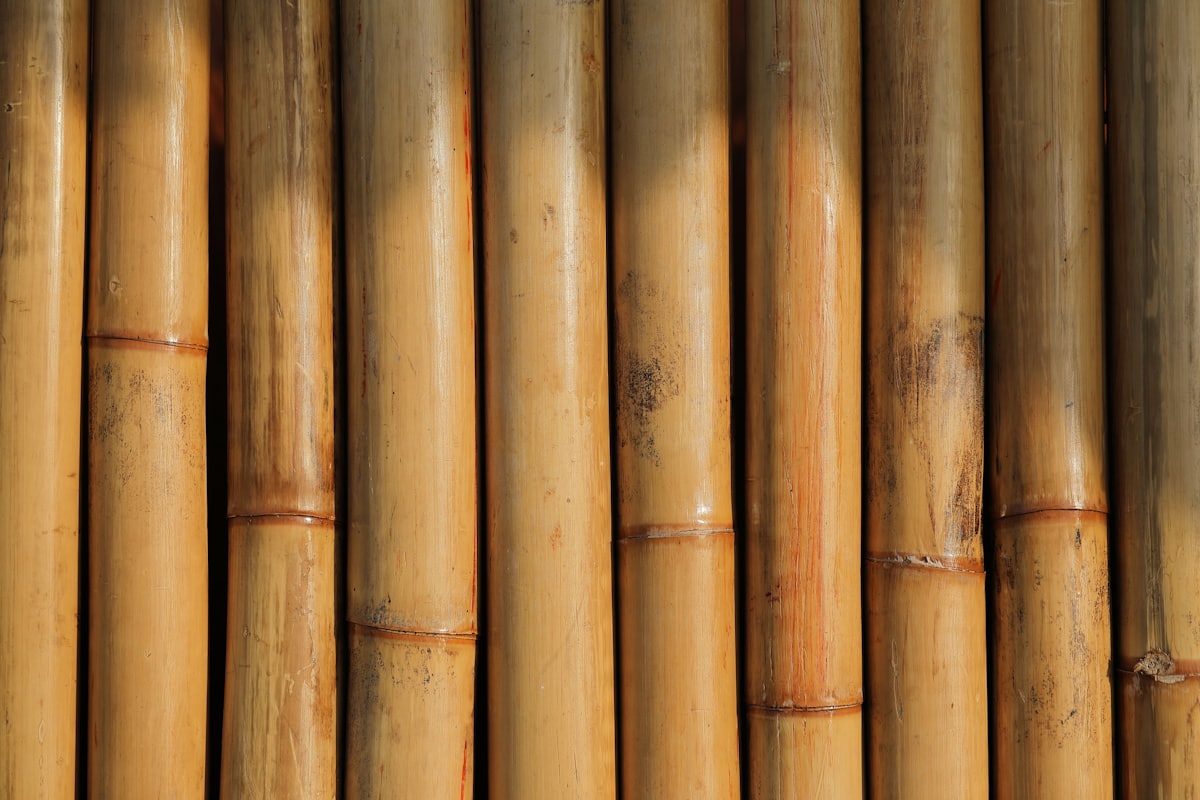
Raw bamboo — whole culms (poles), used structurally more or less as they grew.
Engineered bamboo — culms split, planed, treated, dried and re-assembled with adhesives into laminated bamboo lumber (LBL), strand-woven bamboo (SWB), or panel products.
I spent my post-graduate research years at Aalto University working on bio-based material systems before returning to Indonesia, and the honest answer I give clients is this: the comparison is less “natural vs. industrial” and more “grown structure vs. manufactured composite.” Each earns its place differently.
Part 1 — Raw bamboo: a grown structural composite
What you are actually building with
A bamboo culm is a naturally optimized tube: dense, silica-rich outer fibers around a softer parenchyma core, stiffened by nodes at intervals. In the species we specify most in Bali:
Species (local name) | Typical use | Wall thickness | Indicative culm Ø |
|---|---|---|---|
Dendrocalamus asper (petung) | Primary columns, trusses | 15–30 mm | 120–200 mm |
Gigantochloa apus (tali) | Rafters, battens, weaving | 6–12 mm | 40–80 mm |
Bambusa blumeana (duri) | Secondary structure | 10–20 mm | 60–120 mm |
Gigantochloa atroviolacea (hitam/wulung) | Exposed finish work | 8–12 mm | 50–100 mm |
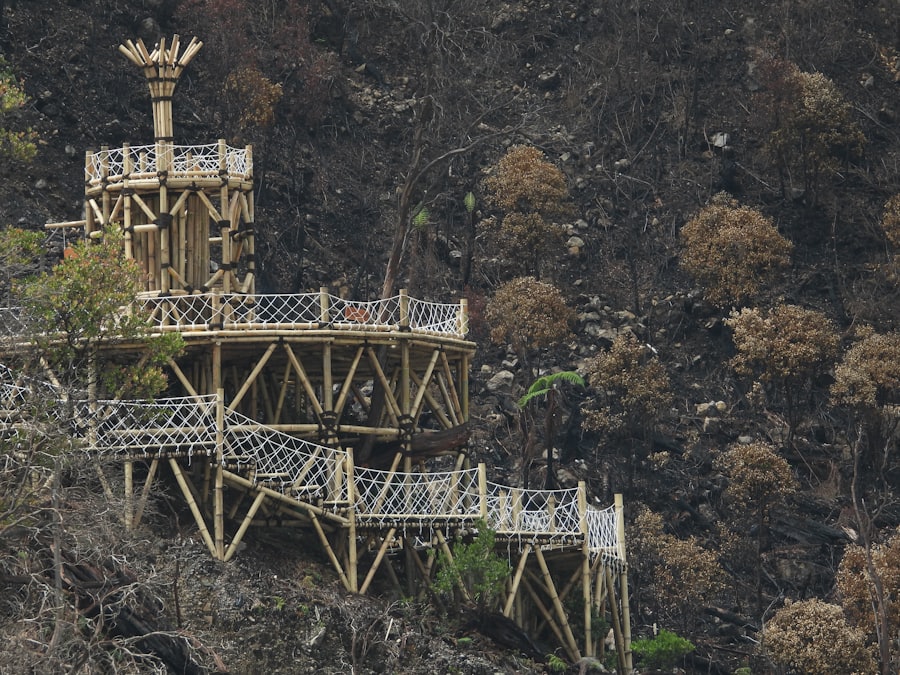
Tensile strength parallel to the fiber is the headline number — dense outer-wall fiber bundles can test in the range of 150–300 MPa, which is why the “vegetal steel” nickname exists. But the culm is highly anisotropic: strong along its length, weak across it. It splits easily under transverse stress, crushes at unreinforced bolt holes, and its hollow section makes conventional moment connections impossible. Good bamboo engineering is therefore mostly connection engineering: fish-mouth joints, injected mortar-and-threaded-rod node connections, lashings, and geometry that keeps members in axial load.
The three failure modes — and what actually controls them
1. Beetles (the starch problem). Untreated bamboo is a sugar delivery system. Powderpost beetles (Dinoderus minutus) attack the starch stored in the parenchyma; an untreated culm in a Bali building can be reduced to powder in one to three years. Control levers:
Harvest age 3–5 years. Younger culms carry more starch and less lignified fiber; older culms begin to lose strength. We reject culms without a credible harvest record.
Dry-season harvest and traditional post-harvest practices (standing the cut culm in the clump for days to let the leaves transpire residual starch) measurably reduce starch load.
Boron treatment. The regional standard, popularized in Indonesia by the Environmental Bamboo Foundation: soaking in a borax/boric-acid solution (commonly ~5 % w/v), either by full immersion for 1–2+ weeks or by vertical soak diffusion through the pierced node diaphragms. Boron is a fixed-dose insecticide and fungistat with low mammalian toxicity — but it is water-soluble and will leach out. A boron-treated culm is protected for decades indoors and roughly not at all if it is rained on repeatedly. This single fact drives half of our detailing.
2. Fungal decay. Above ~20 % moisture content, fungi metabolize the culm. In Balinese humidity, bamboo equilibrates around 12–18 % MC under cover — safe — but wicks water fast through cut ends and splits. Decay risk is therefore a detailing problem: ground clearance, drip edges, ventilated connections.
3. UV and weathering. Direct sun degrades lignin, greys the skin, and opens micro-checks that admit water. Exposed raw bamboo also moves: culms shrink across the diameter as they dry, and cyclic wet-dry swings open longitudinal splits.
The design rule that follows: “big hat, good boots”
Every durable raw-bamboo building in the tropics obeys the same envelope logic we apply across our work at Pulau Studio:
Roof overhangs of 1.5 m+ (“big hat”) so that driving rain rarely wets structure. On our pavilion studies this is also what makes the deep, shaded verandas that do the passive-cooling work.
Elevation off grade on stone or concrete plinths (“good boots”) — minimum 300 mm, ideally more — with a capillary break. Bamboo never touches soil.
No horizontal water traps. Culm orientation, end-capping, and connection geometry all drain.
Replaceability. We detail secondary members to be individually swappable. A bamboo building maintained this way is not a 10-year building; well-documented treated-and-sheltered structures in the region are now passing 20+ years in service.
Part 2 — Engineered bamboo: the composite that behaves like timber
What it is
Engineered bamboo starts by destroying the tube. Culms are split into strips, planed to remove the adhesion-hostile silica skin, boron-treated, kiln-dried to 8–12 % MC, then reconstituted:
Laminated bamboo lumber (LBL / “laminated bamboo”) — planed strips glued in layups like glulam. Density typically ~600–700 kg/m³. Machinable with ordinary woodworking tooling; clean, contemporary appearance.
Strand-woven / scrim bamboo (SWB) — crushed fiber bundles saturated in resin and hot-pressed to very high density (~1,000–1,200 kg/m³). Extremely hard and abrasion-resistant; the standard for high-traffic flooring and decking-grade boards.
Bamboo panel/ply products — for cabinetry, linings, and joinery.
Why engineers relax around it
Reconstitution deletes the three properties that make raw culms difficult: variability, hollowness, and anisotropic splitting. Published mechanical testing on laminated bamboo consistently places it at or above premium hardwoods — indicative ranges from the literature:
Property (indicative, parallel to grain) | Laminated bamboo | Strand-woven bamboo | Teak (for reference) |
|---|---|---|---|
Density | 600–700 kg/m³ | 1,000–1,200 kg/m³ | ~650 kg/m³ |
Bending strength (MOR) | ~70–90 MPa | ~120–180 MPa | ~90–100 MPa |
Stiffness (MOE) | ~9–11 GPa | ~12–16 GPa | ~10–12 GPa |
Dimensional behavior | Stable, timber-like | Very stable | Very stable |
(Ranges compiled from peer-reviewed laminated-bamboo studies and manufacturer test data; project-specific values must come from the supplier’s certified test reports.)
Equally important for us: rectangular sections take rectangular connections. Bolted plates, screwed hangers, standard timber engineering software inputs. For Indonesia’s post-2021 PBG permitting regime, where the reviewing engineer wants numbers, an LBL beam with a test certificate is a far easier conversation than a culm truss — for which the applicable reference is SNI 8970:2020 (structural design with bamboo) and, frankly, a structural engineer experienced enough to stand behind it.
The honest caveats
Adhesives and embodied energy. Strip processing, kiln drying, resin (typically phenol- or melamine-formaldehyde systems; low-emission grades exist and should be specified — ask for E0/E1 certification) and hot pressing all cost energy. Engineered bamboo’s embodied carbon is a multiple of a raw culm’s, though still generally favorable against aluminum, steel, and imported hardwoods once biogenic storage is counted. We treat this as a budget to spend where it buys performance.
Glue lines are the weather point. Exterior exposure stresses the adhesive bond through moisture cycling. Exterior-rated product exists, but our default is the same as for raw bamboo: keep it out of the rain, or specify SWB decking grades explicitly rated for exposure and accept a maintenance coating cycle.
Cost. In Bali today, raw treated petung is one of the cheapest structural materials per span you can buy. Quality LBL — much of it processed in Java or imported — prices closer to mid/high-grade hardwood. As local processing capacity grows this gap is narrowing, but it is real.
It is not “more sustainable” by default. A raw culm harvested 30 km away and boron-dipped is close to the lowest-carbon structural element available anywhere. Engineered bamboo’s sustainability case is about substituting concrete, steel, and slow-growth hardwood — not about beating the pole it was made from.
Part 3 — How we actually decide (the Pulau Studio matrix)
Application | Our default | Why |
|---|---|---|
Long-span roof structure, pavilions, expressive trusses | Raw culm (petung), boron-treated | Highest strength-to-weight and lowest carbon for the job; the curvature and rhythm of culms is the architecture |
Primary beams/columns needing calculable, permit-ready sections | Laminated bamboo or hybrid with timber/steel nodes | Predictable section properties, standard connections, cleaner PBG engineering review |
Flooring, stairs, decking | Strand-woven bamboo | Hardness and wear resistance beyond most hardwoods |
Cabinetry, wall linings, screens | Bamboo panel/LBL | Stability, machinability, consistent finish |
Anything within splash or soil contact | Neither — stone, concrete, or terrazzo plinths | Boron leaches; adhesives fatigue; water always wins |
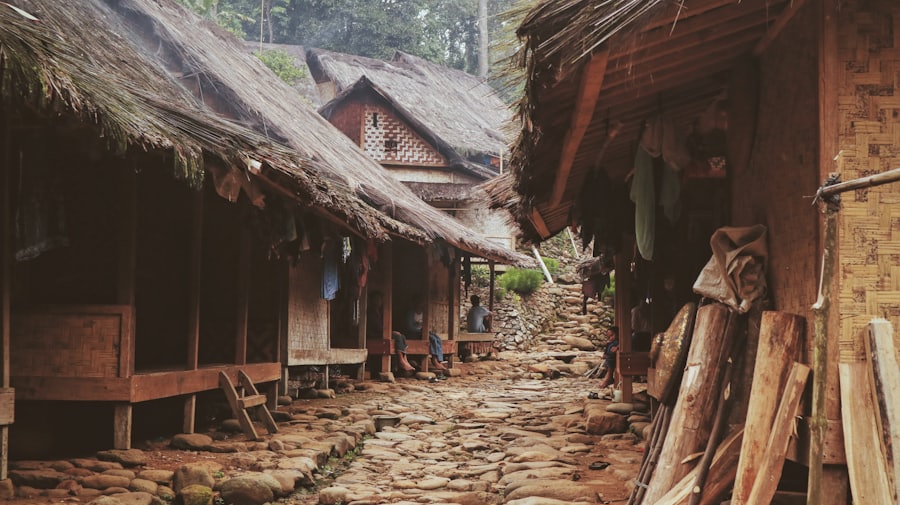
Woven ceilings, sun screens, secondary texture | Raw tali/hitam | Cost, craft continuity with Balinese weavers, easy replaceability |
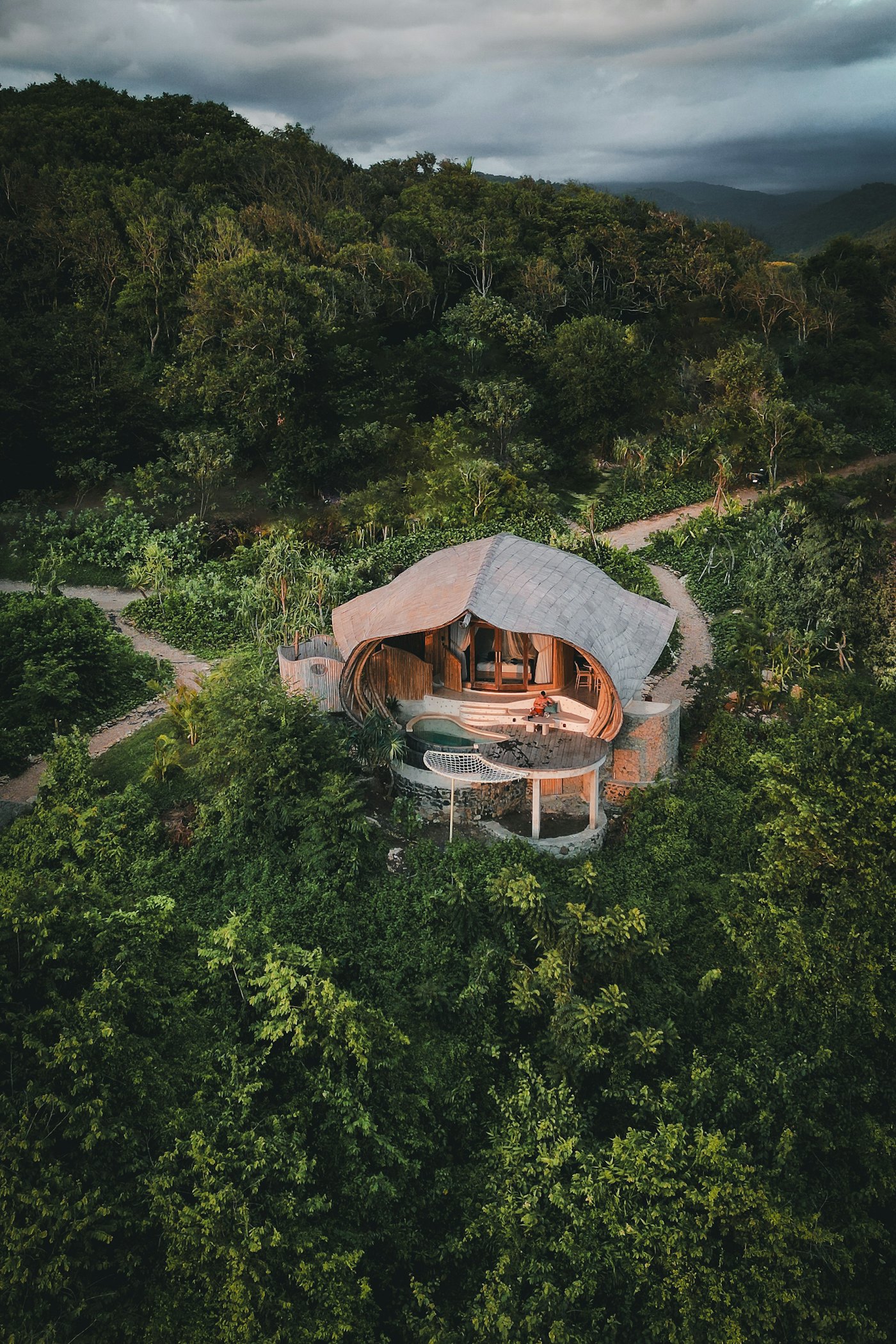
Two of our current design studies pair a raw-petung roof canopy over an engineered-bamboo and reclaimed-teak interior frame — the culms doing what culms do best (span, shade, silhouette) while the composite carries the calculable loads and the joinery. That division of labor, not a winner-takes-all choice, is where bamboo architecture in Bali is heading.
A note on specification — questions to ask any supplier
Whether raw or engineered, the paperwork matters more than the brochure:
Species and harvest age (raw): documented, 3–5 years, dry-season cut.
Treatment chemistry and retention (raw): boron concentration, method (immersion vs. VSD), and duration — not just “treated.”
Moisture content at delivery: kiln- or air-dried to service MC; site-check with a meter.
Adhesive class and emissions (engineered): exterior vs. interior rating, E0/E1 formaldehyde class.
Certified structural test data (engineered): MOR/MOE per batch or product line, referenced to a recognized test standard.
Fire strategy: bamboo chars predictably like timber, but the reviewing engineer will want the approach stated — section sizing for char, intumescent coatings on engineered members where required.
If a supplier cannot answer these in writing, the material is decorative — whatever it is holding up.
FAQ
How long does a bamboo house last in Bali?
Untreated and exposed: 1–3 years. Boron-treated, kept dry with deep overhangs and raised plinths, and maintained: multiple decades — regional precedents are now well past 20 years. Longevity is a design and treatment outcome, not a material constant.
Is engineered bamboo stronger than raw bamboo?
Per fiber, raw bamboo’s outer wall is the strongest form. Per usable structural section, engineered bamboo wins on predictability: uniform rectangular members with certified bending strength comparable to or exceeding teak, and connections any timber engineer can design.
Is bamboo permitted for structural use under Indonesia’s PBG system?
Yes, with engineering justification. SNI 8970:2020 covers structural bamboo design; engineered bamboo with certified test data generally passes review more smoothly. Work with an IAI-registered architect and a structural engineer experienced with the material.
Which is more sustainable?
A locally harvested, boron-treated culm has the lowest embodied carbon of any structural option in Bali. Engineered bamboo carries processing and adhesive burdens but substitutes far more carbon-intensive materials and uses a resource that regrows in 3–5 years. Both outperform imported hardwood, steel, and structural concrete on carbon in most life-cycle comparisons.
Does Pulau Studio design with bamboo?
Bamboo — raw and engineered — is one pillar of our material research alongside reclaimed teak, volcanic stone, and rammed earth. If you are planning a home, hospitality, or commercial project in Bali and want a structure that breathes with the climate, start a conversation with us.
Talisa Dwiyani is the founder of Pulau Studio in Ubud, Bali. Her practice, Adaptive Archipelago Architecture, combines Indonesian vernacular knowledge with material research training from Aalto University, Finland.